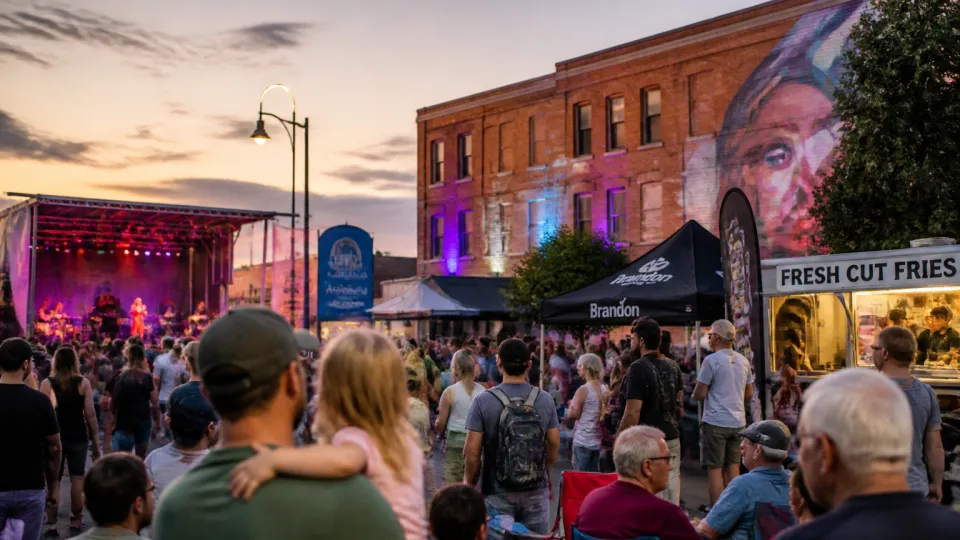
On a late summer evening in Brandon, the low sun catches the brushed metal of a festival stage and turns it to a kind of quiet gold. Children run between food tents; an older couple leans against a temporary fence, listening as a young guitarist plays a familiar tune with an unfamiliar voice. Around them, people from neighbourhoods a half hour away—farmers, students, recent arrivals—stand shoulder to shoulder. For a few hours the city is not a collection of institutions and services but a single public room: noisy, uneven, and alive.
That scene is not an accident. It is the product of decades of steady cultural investment in the Westman region—efforts both institutional and improvisational that have shaped how Brandon and its neighbouring towns understand themselves. These investments have not always looked glamorous. They have involved the slow accrual of rehearsal spaces, the conversion of old storefronts into galleries, the uncertain accounting of volunteer hours, and the occasional fight for municipal support. Yet together they have produced an infrastructure that does more than entertain: it convenes, it trains, it sustains livelihoods, and it makes civic life legible.
Brandon University has long been a hub. Its School of Music has drawn students from across the prairies, bringing conservatory-level training to a city of modest size. Recital halls and community choirs function as both educational spaces and civic forums—places where young performers learn craft and older residents find renewed purpose. The Art Gallery of Southwestern Manitoba, likewise, has anchored visual arts locally, mounting shows that confirm a regional perspective while connecting artists with provincial and national networks.
Community theatres, amateur dance troupes, and makers’ co-ops have proliferated in smaller towns: places where a high school auditorium doubles as a civic theatre and pottery classes are taught by retired teachers who still love to shape clay. These are the invisible scaffolds of cultural life. "You remember the first time you saw performance in person—how it rearranged the importance of a place," a longtime volunteer at a downtown gallery told me. "That memory is what keeps people coming back, and it builds the next generation of makers."
Festivals have been particularly consequential. The annual music and arts gatherings in Brandon bring international acts but, crucially, foreground local performers. They translate a weekend of shows into seasonal income for cafés, hotels, and longtime service providers. More importantly, festivals create visibility for community artists: a painter selling a handful of canvases on festival weekend is often a painter who will be invited into a gallery the next year, who will teach workshops, who will mentor apprentices.
This cultural density has ripple effects that are hard to quantify but easy to feel. Young families deciding where to plant roots cite the availability of music lessons, theatre programs, and evening readings as reasons to stay. Retirees volunteer as technicians and ushers; entrepreneurs find audiences for craft goods; students find internships that keep them in the region rather than pushing them toward larger cities. In that sense, arts infrastructure functions as both anchor and ladder.
There is, however, a necessary reappraisal underway. Communities across Westman are asking whose stories get the stage and who gets to shape public culture. Indigenous artists and cultural leaders are increasingly prominent, insisting that reconciliation be not just ceremonial but structural—about who sits on boards, who curates exhibitions, and how proceeds are shared. Public art projects now often begin with consultation; festivals are developing programming that centers Indigenous language and perspectives. "Art has to be more than a token gesture," an Indigenous cultural worker explained. "It has to change how money and attention flow."
Digital change is another frontier. Rural arts organizations have learned the hard lesson of the pandemic: reach depends on access. Streaming performances widened audiences but also exposed digital divides. Libraries, community centres, and universities have responded by expanding recording facilities and offering media training—attempts to translate local practice into durable forms that can travel without leaving home.
Looking forward, the region faces familiar challenges—funding unpredictability, the loss of rehearsal spaces to development, the brain drain of emerging artists—but it also has clear assets. Tangible institutions like university music departments and galleries sit beside a dense network of volunteers and small enterprises that can adapt. If municipal leaders and philanthropic actors see arts infrastructure not as discretionary luxury but as long-term civic investment, the payoffs are real: stronger local economies, better mental-health outcomes, and richer public life.
What matters most, however, is less policy than relationship. The most resilient projects are those rooted in generous exchange: seasoned artists teaching in high schools without pay, festival organizers opening stages to newcomers, elders guiding public art consultations. In a region where geography can feel like a limit, these relationships expand the field. The prairie light doesn’t change the music, but it shapes how we see it. That shared visibility—of makers, elders, students, and neighbours—might yet be Westman’s most durable cultural export.