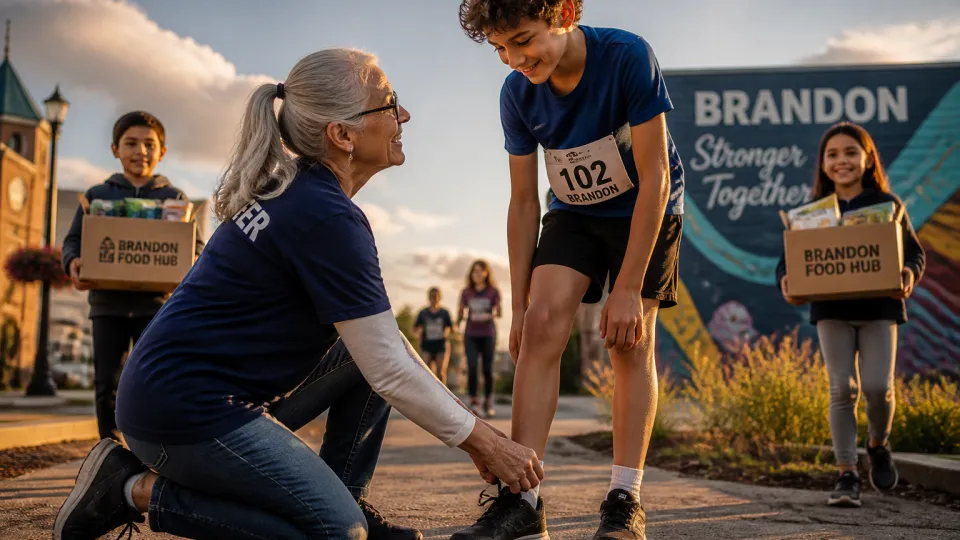
Eileen drives the cargo van three mornings a week, windows down against a prairie wind that always smells faintly of grain. She is in her late sixties and has been collecting weekly donations for the food bank for more than a decade. Last winter, when a blizzard pinned the city down for 48 hours, she broke one of her hands while shovelling snow leaving a volunteer-shaped hole on the schedule that managers discovered only when food donations began to pile up at the back door.
"We learned how brittle our system is," the food bank's volunteer coordinator, Lara, told me in March. "Not brittle like people — brittle like structures. We depend on a set of dependable people, and when one of them goes, everything shifts."
Across Brandon and the surrounding Westman region, that brittle system is weathering slow but profound change. Long-standing patterns of volunteer labour — seniors who filled hospital auxiliaries, church groups staffing soup kitchens, high schoolers earning credits through weekly shifts — are unraveling and recomposing into new forms. Organizations that have relied for decades on a stable corps of unpaid workers are confronting a paradox: more community need, but fewer sustained hands to meet it.
From local non-profits to municipal services, leaders describe the same trajectory. During the pandemic, many regular volunteers stepped back — older adults shielding themselves, parents juggling remote learning. Some never returned. At the same time, the crisis created momentary surges of civic energy: neighbours organized meal trains, students assembled PPE, newcomers coordinated mutual aid. Those bursts of participation left organizations with a new question: how do you turn episodic goodwill into durable capacity?
The answer has been messy, revealing both creativity and strain. At one elementary school, the breakfast program shifted from daily volunteers to a streamlined delivery model run by two paid staff and a roster of short-shift volunteers. The result: fewer people needed, but also fewer opportunities for the kind of informal mentoring that used to happen over cereal bowls. "We'd lose that snapshot of a kid's life when an afternoon volunteer notices a bruise or a change in mood," a teacher involved in the program said.
Other organizations have embraced micro-volunteering and on-demand platforms. A coalition of libraries and heritage groups in Westman piloted weekend pop-up shifts advertised through social media and a municipal volunteer portal. Younger volunteers responded to the clarity and flexibility: sign up for a three-hour archive-cataloguing session, complete it, and move on with their weekend. But while the model fills immediate tasks, it doesn't always create the continuity required for more sensitive roles like hospital support or youth mentorship.
Immigrant and Indigenous volunteers are increasingly central to bridging formal service gaps. A newcomer-led initiative in Brandon recently mobilized interpreters for health clinics, translating not only language but cultural expectations — a contribution coordinators called indispensable. Indigenous elders, too, have been central in community work, offering ceremonies and culturally anchored support that paid systems struggle to replicate.
Yet these human assets are undervalued in a funding environment that prizes measurable outputs. Several small charities reported using limited project grants to hire temporary coordinators just to keep up with screening, training, and insurance requirements. That creates a feedback loop: as administrative demands rise, less energy and money go to the on-the-ground programs that actually mobilize volunteers.
There is also an economic tension. With labour shortages across sectors and the rising cost of living, some roles once performed by volunteers are being shifted to paid staff. Municipalities and hospitals have hired for positions that used to rely on unpaid labour, stabilizing services but shrinking volunteer opportunities. For older volunteers like Eileen, that change can be double-edged: programs become more reliable, but the social fabric that drew people to volunteer in the first place frays.
Despite these tensions, Westman's civic life has not dimmed. It is reconstituting. Employers are experimenting with paid time-off for volunteering, school boards are building service-learning into curricula, and a nascent data-sharing effort among Brandon nonprofits aims to match volunteers with roles that fit both skill and schedule. These experiments point to a future where volunteering is less an expectation and more a negotiated exchange: meaningful roles, clear training, and recognition in return for time.
Policy, too, matters. Local leaders I spoke with argued for modest but targeted investments: funding for volunteer coordinators, streamlined background-check systems, and shared training modules. Such infrastructure would lower the administrative threshold that currently consumes small organizations. Equally important is reframing volunteerism from nostalgia to infrastructure — seeing it as part of the civic economy that needs upkeep, not only gratitude.
Back at the food bank, Eileen has recovered and is teaching younger volunteers how to pack hampers efficiently and with dignity. "If we want this to last," she said, "we have to teach people how to do it and why it matters. You can't pass along a thing if you keep it in your head." That sentence — practical, stubborn, and generative — captures the work ahead: to convert compassion into competence, and compassion's sporadic sparks into a community apparatus capable of sustaining care.
If Westman wants a resilient future, it will need to fund and design for volunteerism that meets modern life: shorter commitments, clearer roles, cultural competence, and administrative support. Doing so will not only preserve essential services; it will reconnect neighbours in ways that a payments ledger cannot measure.